What is Tramming
Tramming a CNC machine involves aligning the spindle perpendicular to the machine’s table to ensure accurate and even cutting. This process typically uses a dial indicator to measure and adjust for any tilt or misalignment in the spindle head. Proper tramming improves surface finish, prolongs tool life, and ensures precise, consistent machining results.
The two processes to adjust tramming are:
Tilt (or roll) refers to the side-to-side tilt of the spindle head
Nod (or pitch) refers to the front-to-back tilt of the spindle head relative to the table.
To tram the CNC, you’re adjusting the spindle head so it’s perfectly perpendicular to the table across the X-axis. Here’s the general process:
Surface your spoil board first to ensure it's parallel to the gantry
Mount a dial indicator in the spindle or collet, with the indicator tip contacting the table surface.
Sweep the indicator by rotating the spindle 180° from left to right across the table — keeping the same radius from the spindle center.
Compare the readings at both sides. If there’s a difference, it means the spindle head is tilted.
Follow the directions below for adjusting the LongMill or AltMill
Quick Links
LongMill
Tilt Adjustment
- Loosen the 8 small screws on the gantry plate behind the router/spindle
- Tilt the router mount left or right to the desired angle till the dial indicator reads the same on both sides.
- Tighten the 8 small screws.
Nod Adjustment
- Raise the router to the top and remove the router from the mount
- From the back of the LongMill, loosen the 4 screws holding the router mount to the gantry plate. Do not remove them. Top Tip: Insert the Allen under the drag chain to access the screws
- To adjust, Use shim stock or a cheap set of feeler gauges for your adjustment
- To tilt the router/spindle forward, shim on top of the screws behind the router mount
- To tilt the router/spindle backward, shim under the screws behind the router mount
- To tilt the router/spindle forward, shim on top of the screws behind the router mount
- Tighten the screws and reinstall the router/spindle.
Altmill
Tilt Adjustment
- On the AltMill, tram alignment is preset by a series of precise reference edges and alignment tools through the frame and gantries. At the spindle mount, tram alignment is set by the use of two shoulder screws. Using these as a ‘default’ will generally mean that your machine should be quite well trammed, but in some cases, a small adjustment may be necessary.
- Checking for tram alignment will typically be done using a tramming arm tool which holds one or two dial indicators, used to ‘sweep’ across the bed/wasteboard surface to find high and low spots. Some specialized tools such as the SST tram tool exist to make this easy, but it is otherwise possible to find a way to mount a dial indicator to the rotating axis of your spindle.
- To allow for adjustment of this, simply swap the left shoulder screw, to use the ‘Eccentric Bushing’, and extra M6-25mm button head cap screws inside this hole instead. Slightly loosen all four screws securing the spindle mount to allow the mount to pivot.
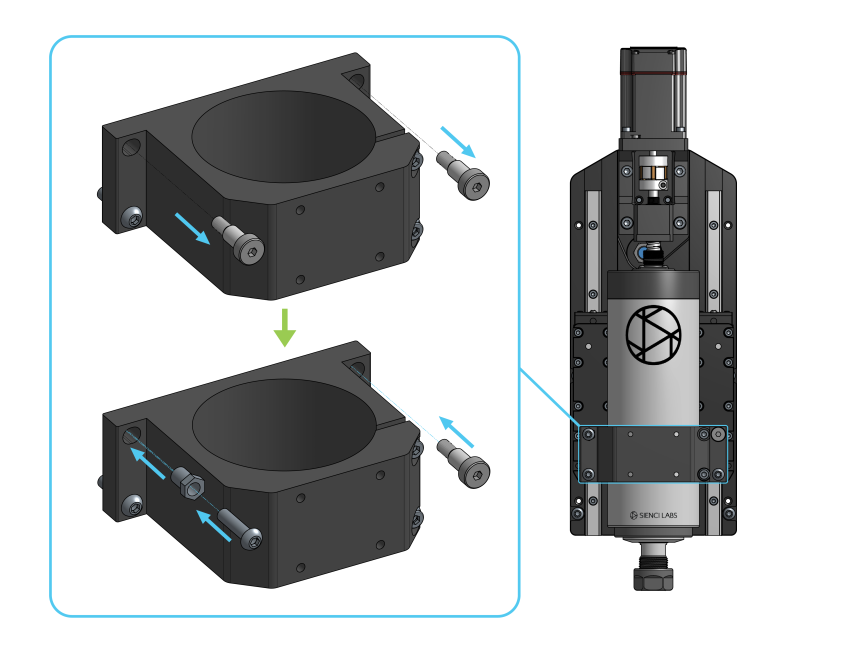
- To finely adjust the tram of the spindle, use the small end of the included AltMill wrench to carefully rotate the hex of the eccentric bushing as shown below. Depending on where the eccentric bushing is angled, turning the wrench will cause the spindle to move some small amount.
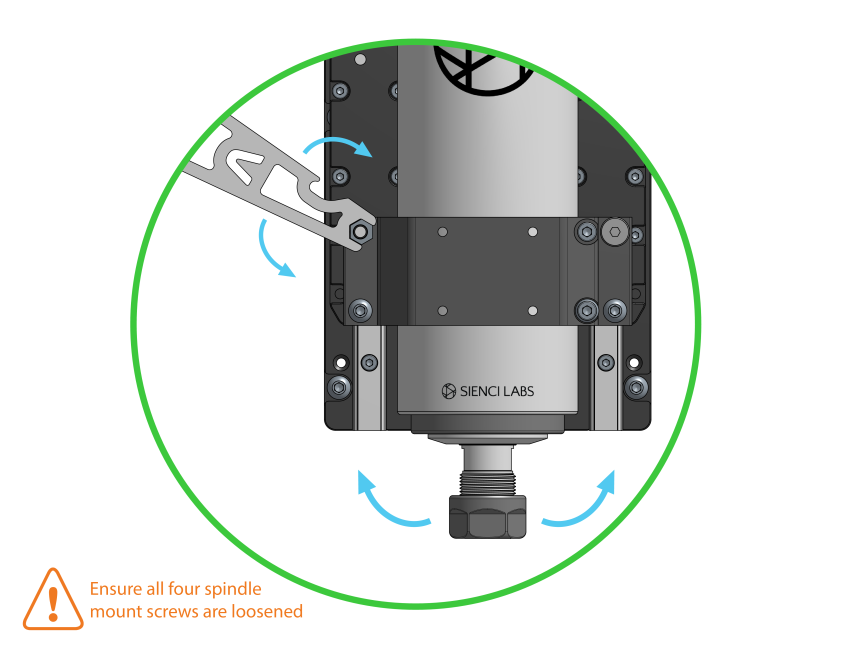
- For very fine adjustment, it may sometimes be necessary to gently knock the top of the spindle with a small rubber mallet, or the back of a screwdriver handle. Once finished, simply tighten all four screws.
Nod Adjustment
- Loosen the 2 shoulder bolts, don't remove them
- Loosen the 4 mounting screws
- Use shim stock or a cheap set of feeler gauges for your adjustment
- To adjust:
- To tilt the router/spindle forward, shim beside the top screws in between the plates
- To tilt the router/spindle backward, shim beside the bottom screws in between the plates
- Tighten the screws and shoulder bolts
Video Examples
LongMill
AltMill
DO NOT USE IDC WOODCRAFT'S VIDEO, his method of tramming in the nod direction using eccentric bushings causes misalignment of the motor and ballscrew.